Current policies lock in irreversible cryosphere collapse
Earth's frozen regions face permanent damage as melting accelerates six times faster than in the 1990s, with current policies set to overshoot the 1.5C Paris target and cause irreversible losses of glaciers and permafrost.
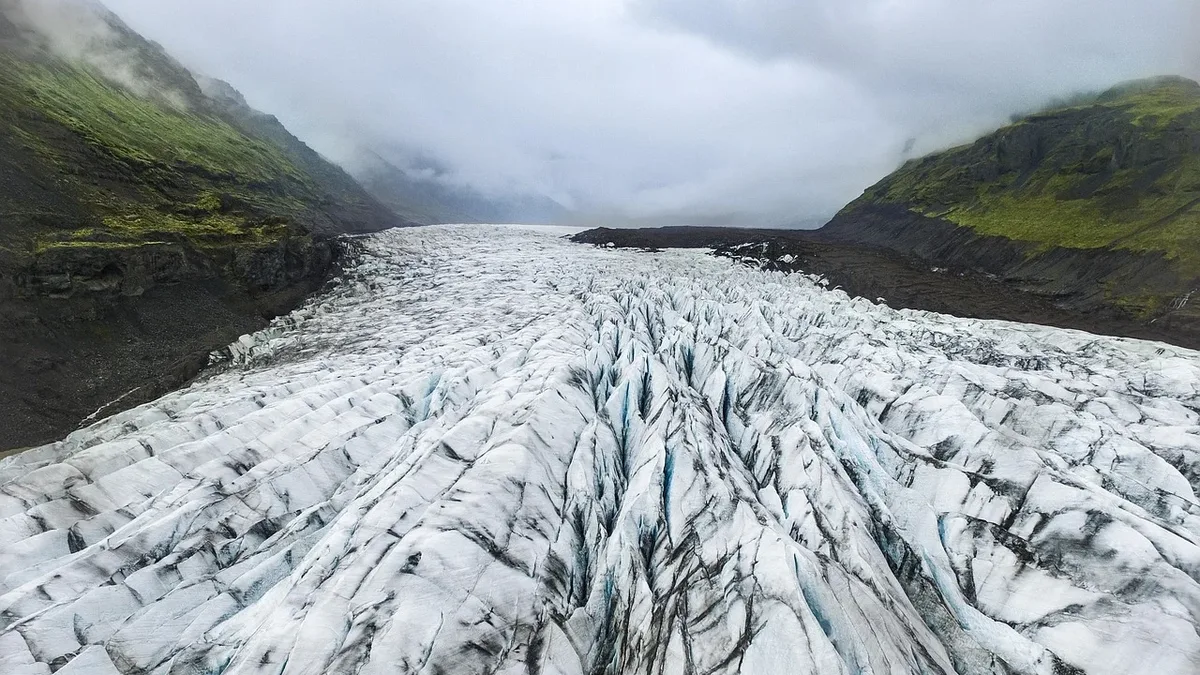
Melting in Earth's frozen regions is accelerating six times faster today than it was in the 1990s. Irreversible damage to ice sheets, sea ice, mountain glaciers, and polar oceans is locked in under current emissions trajectories, according to a new scientific report.
Polar ice sheets covering Greenland and Antarctica are melting about six times faster now than they were three decades ago. Sea ice is disappearing at record speed and recovering more slowly than previously thought. These changes, alongside rising sea levels and acidifying polar oceans, are irreversible on human timescales.
Consequences of a high-temperature overshoot
The high overshoot expected under current policies, with peak temperatures of about 3C, would thaw nearly all near-surface permafrost. It would also decimate mountain glaciers. Under a trajectory resulting in 2.8C of global heating, glacier ice mass would be reduced to below 10% in the Rockies, Alps, Iceland, and Scandinavia.
A comparison of outcomes for key mountain ranges under different warming scenarios shows stark differences.
| Region | Ice Mass Under 1.5C Warming | Ice Mass Under Current Policies (~2.8C) |
|---|---|---|
| Rockies, Alps, Iceland, Scandinavia | 20-35% remains | Below 10% remains |
| Hindu Kush Himalayas | 83% remains | 41% remains |
In the Hindu Kush Himalayas, current policies would leave just 41% of the ice mass. Limiting warming to 1.5C would preserve 83%.
Permanent loss and the 1.5C threshold
Much of the damage to the cryosphere would be permanent even if global temperatures were later brought back down to 1.5C. Glacier melt raising sea levels is one such permanent loss. The world's frozen regions face irreversible damage as global warming approaches the 1.5C Paris Agreement limit.
To preserve about 70% of current glacier volume over centuries, long-term heating would need to be brought back down to 0.8C. A safe, long-term temperature limit for polar ice sheets lies much closer to 1.0C of global heating, and possibly even lower.
Urgency for policy action
Snow and ice respond rapidly to every fraction of a degree of warming. Most systems, however, will take centuries or millennia to recover after an overshoot. Temporarily exceeding 1.5C does not make Paris Agreement goals irrelevant. It makes them more urgent to avert catastrophic cryosphere damage.
Minimizing impacts from ice loss and giving society the best chance to adapt will require bringing temperature well below 1.5C, preferably towards 1C. Extreme effects on the cryosphere mean temperatures must rise above 1.5C for as short a period as possible. Enough planet-heating carbon must be removed from the atmosphere to bring long-term warming down ideally below 1C by 2150.
Current policies would also make severe and possibly abrupt disruption to ocean circulation likely and lead to widespread acidification of polar oceans. The planet has already heated by 1.3C since pre-industrial times. Failures to curb emissions have led scientists to conclude some level of overshoot is now inevitable.
The report, written by 80 scientists brought together by the International Cryosphere Climate Initiative and the UN Environment Programme, documents rapid and accelerating melting. It states that returning to 1.5C or below by 2100 is possible with sufficient political ambition and urgency. This requires speeding the transition away from fossil fuels and scaling up sustainable carbon drawdown.